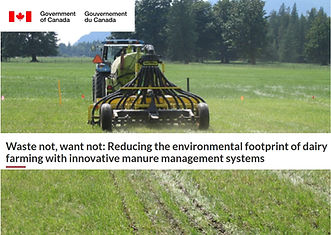
The Advantage of Solid/Liquid Separation
What manure management options are available to Canadian farmers, and why partitioning waste into solid and liquid fractions is beneficial.

Farm animals produce a lot of manure: according to Statistics Canada bulls and beef cows make around 40 kg/day, steers and heifers around 25 kg/day, and even calves contribute to the mix with 12 kg/day. Milk cows were found to be the top producers, with 62 kg of manure per day, a whopping 10% of their average individual weight!
Canadian livestock operators have a few different options to manage this by-product. While manure is considered to be a good (and cheap!) fertilizer, there are many concerns associated with its production:
-
Manure management can be costly
-
Manure is a potential contaminant for waterways and groundwater, and might cause nutrient accumulation in the soil
-
It is a nuisance due to its odor and the insects and critters it may attract
-
It could cause risks to human health if not managed properly
Since manure can only be applied on fields at certain times of the year, storage becomes a necessary practice for livestock operators. In order to protect the environment and the people working on farms and living nearby, storage systems must include liners (clay, concrete, synthetic, etc), loading and emptying manure into/from storage must be done in a way to minimize gas release and leakage, and the storage facilities must be constantly monitored.
Manure management can be simplified by treatment to alter its state, often to change its moisture content. This makes it easier to store it, transport and apply it on land further from the operation, and to transform it into value-added products. Additionally, raw manure contains an imbalance of nutrients, where a low nitrogen to phosphorus ratio limits its applicability for precise soil amendments. Solid-liquid separation is a treatment that separates manure slurry into the two different fractions: a nitrogen-rich liquid and a thick sludge where most of the phosphorus remains.
The cheapest way to achieve this separation of slurry wastewater from livestock operations, especially in dairy production, is to allow it to settle naturally in storage tanks or lagoons. For quicker results there are other options, which come at various operational costs, including mechanical separation using screens and centrifugal separators, which are often coupled with coagulation/flocculation, although the latter can also be exploited as a stand-alone option.
Controlling the level of moisture in manure slurry can then allow operators to explore value-added processes such as composting or anaerobic digestion.

External Links For More Information